Tuesday, August 21, 2012

Child's Brain Building: Parents Have A Big Role To Play

A mom of a playgroup child told me last week how happy she is to notice the numerous learnings her child has picked up so soon. She is also happy to see the new positive changes in her child. We often get such reactions and compliments. And, of course, it reinforces our faith in our methodology. But today I would like to share the next step in the process of ‘Brain Building’ of your child.

Let us figure it out. A child is born with over 100 billion or 10000 crores brain cells or neurons – sixteen times the world population! And each of these cells is capable of making over 15000 connections. Through these ‘connections’ a child internalizes the experiences and acquires new learnings. Now, what should be our role? 
Obviously, learnings should be preserved and the stock should grow. Interestingly this stock does NOT grow automatically like a savings bank account. It will rather vanish if not strengthened. Yes, if they are not used, the learning pathways are obliterated. This is called the use it or lose it” principle.

This is what you should be doing – helping the child to use a ‘connection’ repeatedly so that it becomes permanent in the brain. Repeat and revise what your child is learning at school. Please note that we are not promoting rote-learning. It should not be memorizing by repetition, it should be understanding, perceiving and comprehending by revision.  And it should be fun. No stress, no strain. A regular routine will help a long way.

Sensory learnings, activity-centric knowledge and words-phrases based language connections should be inculcated in the early years. Parents have a big role to play in this. You’ll be happy for doing this as you’ll proudly see your little one blooming. 

As they say, the first years last forever’.

Friday, January 13, 2012

How to answer those never ending questions?

Children come up with series of questions and counter questions. Sometimes these questions may seem totally nonsensical and absurd. Many parents lose patience and end up the whole conversation abruptly with mild snubbing… “Now, it’s enough. Stop asking too many questions.” or  “Your questions never end… now go and play.” or something like that.

This is a flawed attitude as a parent.  If you’ll see it from child’s point of view, you’ll be able to justify it.  And that is important.

We must understand that questions are means of learning. Asking questions is a positive sign in children because it means that the child analyses. Every question, no matter how silly or absurd it may seem, is born of curiosity. And curiosity should be nurtured, not suppressed.  I do agree that even the most articulate and informed parents can’t find satisfying answers to the countless questions of the child. But more than the right answers, right response is required.
Please do not snub—it makes the child feel ashamed. Try to understand that until now you have provided most of the ‘information’ the child has. That is why the child is trying to get answers from you. You should be responsive. A very young child may not understand scientific explanation, so be imaginative and creative. Do not give false information. Retain your child’s faith in you.
Your answers will build the treasure chest of knowledge of your child… that sprouts out of the magical domain of curiosity!

Heralding New Year 2012 : KITE School

We celebrated Christmas and heralded the New Year 2012 with joy and jubilation!!!


Sunday, December 11, 2011

Control That Bragging!

Bragging comes so naturally to children!

Children get into bragging about their possessions and boasting about their ‘achievements’ and experiences, too. They may brag about ‘so many Barbie dolls’ or ‘ten remote controlled cars’ to make an impression on their peers. It could be a part of their innocence, as most child psychologists opine. However they also warn that parents and care-givers should watch that this habit doesn’t grow beyond simply sharing joyous experiences and imaginations.

As long as it is not aimed at hurting or belittling others, it may be considered fine. But parents should get worried if their child is becoming a compulsive bragger or ‘victim’ to other peer-bragger. If your child is mentioning about somebody’s bragging, you should talk to your child to distress him/her and to ignore that friend’s bragging. Reveal that it is not a serious truth. If your child is the bragger then pay attention and train him/her to praise others too. Appreciation begets appreciation.

It is just a part of inculcating positive social behaviour in children. And while doing so even you may learn a thing or two. Because even some of the grown up are no less braggers!

Thursday, September 15, 2011

Are You Buying Expensive Toys?


Now the festive season is on and shopping lists are also becoming longer. Children have an unending demand for newer toys and loving parents exhaust themselves buying expensive toys. But have you noticed that more often these toys end up gathering dust somewhere in the house. Sometimes a toy doesn’t last more than a week. The reason is that the child loses interest if there is nothing to nurture his/her imagination. All expensive battery-operated toys—like a car that runs with flashy lights and annoying siren or a robot that moves and fires—may fancy the child for a while but they don’t enhance any creative skills, hence they don’t engage the child beyond the initial delight. Parents often complain that such an expensive toy is wasted. It should be noted that price of the toy doesn’t put value in the toy. A child plays with the stimulating and involving toy, no matter how expensive or cheap it is. And no matter if it is not a ‘toy’ but a simple kitchen vessel.

 Actually it is a better idea to make ‘toys’ at home! Parents should involve children in ‘creating’ their own toys with household items. This will surely enhance child’s imagination and also engage the child. Even atta can be used as clay which becomes real hard when dried up. Empty boxes and packaging cardboard can be used in many ways.

 This also has a positive side-effect. When a child makes his/her own toy, it also creates an affectionate attachment with that toy. But remember, parents must supervise and guide the child during this.

It will be truly learning with fun!

Sunday, August 21, 2011

When children make-up stories…

Nearly all children make up stories at some point or the other. Often for kids in this age-group, it is not ‘lying’, it is not being ‘dishonest’, it is just ‘pretending’—which is very much a part of their growing up and enhancing creative imagination. Many a time a child lies to cover up something which is not in his/her favour. Sometimes it could be a result of some anxiety when a child wants to avert consequences.  At other times, a child may lie only to impress or get attention.
It is important that you don’t react by getting angry with the child because it may confuse the small kid. Do not label him/her as ‘liar’. Overreacting may result in bringing guilt to the child’s mind and may hurt his/her self esteem. You need to explain the futility of the lie. You may take help of the stories like “The Boy Who Cried Wolf”. And you should re-enforce the importance of honesty and truth. In other words, this is the time of ‘character building exercise’ instead of rebuking your child.

At the same time, it is also important to understand that you should not be jumping to conclusions and make allegations on the basis of these stories. You should use discretion.

Finally, set example by being truthful yourself.
                     

Monday, July 25, 2011

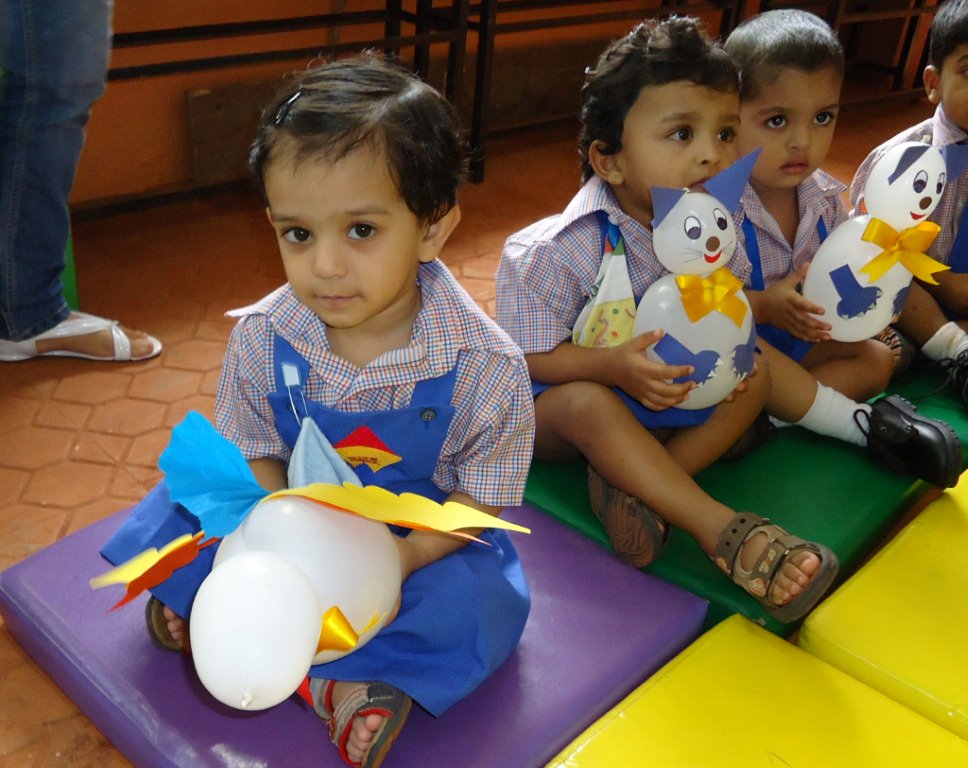
KITE School | Balloons Bloom | Rainy Season Demo


22nd July was quite full of energy at KITE School.

It was a wonderful time with Playgroup kids on Balloons' Day!

Children were pleasantly surprised as they saw balloons taking different shapes and characters.

Many activities and games were played and finally each one got a balloon to take home. Some even got two!


EVE Session

On the same day, Junior and Senior KG Children had first EVE session of this academic year. They came to know many facts and aspects about the rainy season. Senior KG children also had discussion and explanation about 'How does it rain?'. Teachers supported the session with a demo.